
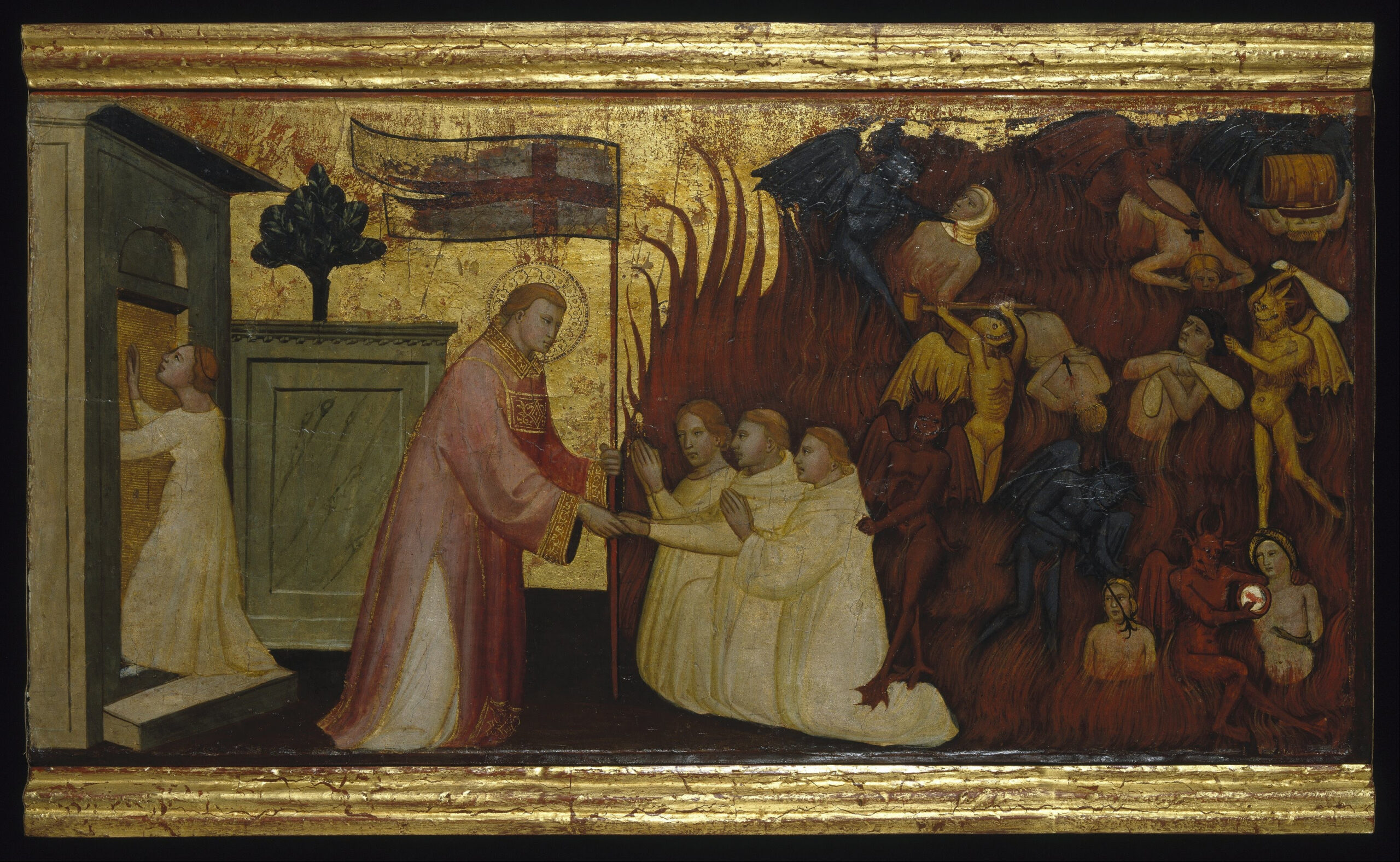
Above: Saint Lawrence Liberates Souls from Purgatory by Lorenzo di Niccolò (1412).
According to a very ancient popular devotion, the month of November is dedicated to the souls in Purgatory. The month begins with a triptych that brings to mind the existence of the three realms of the afterlife. October 31st marks the Vigil of All Saints, traditionally a day of penance and fasting, reminding us of the eternal drama of Hell; November 1st is the Solemnity of All Saints, which evokes the blessed hope of Heaven; and finally, on November 2nd, the Church celebrates the Commemoration of All the Faithful Departed, thus recalling the consoling reality of Purgatory.
But what exactly is Purgatory? In recent years, knowledge of this truth of faith has greatly faded or even become distorted. It is not uncommon to hear that Purgatory is merely “a waiting room for Heaven” or a “loving anticipation” of entering Paradise. Moreover, there is a widespread but mistaken belief that Purgatory is the destination for those guilty of sins not serious enough to deserve Hell — thus fostering the illusion that souls condemned for eternity are extremely few, limited to those guilty of sensational crimes such as murder, massacres, and the like. And perhaps not even those.
This view risks not only reducing salvation to something unconditional, but also bending the logic of divine judgment — as revealed to us by Christ and taught by the Church — to our own reasoning, our conveniences, our emotions, and our subjective perceptions of good and evil. In this article, therefore, I intend to recover and synthesize the Catholic doctrine of Purgatory.
An Important Starting Point: the Anatomy of Sin
To properly understand the doctrine of Purgatory, one must grasp that not all sins are equal. Sin can be venial or mortal. Sins can be distinguished in various ways, and this twofold distinction depends on the type of punishment they require.
A sin is mortal when it meets three conditions: grave matter, meaning a violation of the divine Law revealed in the Decalogue; full knowledge, on the part of the intellect, meaning awareness of what one is doing (it should be noted that this does not refer to awareness of the sinfulness of what one is doing, although invincible ignorance does exist); and deliberate consent, on the part of the will, meaning the absence of internal or external coercion. Mortal sin requires an eternal and irreparable punishment, because it destroys charity.
If even one of the three conditions is lacking, the sin is not mortal but venial. Unlike mortal sin, venial sin does not destroy charity, but inclines the affections toward disorder or roots them in it. For this reason, the punishment God inflicts is temporal, aimed solely at purifying the effect of that disordered act. Mortal sin, on the other hand, nullifies the theological virtue of charity and, in doing so, imprints upon the soul the stain of guilt, altering the subject ontologically before God. In such a case, a supernatural intervention is necessary — the sacrament of Confession — to restore justification and infuse charity once again, that is, the life of grace within us.
It should also be clarified that, although it is true that many venial sins taken together do not constitute a mortal sin,[1] it is equally true that the more frequently a venial sin is committed, the more it requires temporal punishment and can thus predispose the soul to mortal sin. For this reason, it is advisable — though not obligatory — to confess, whenever possible, even venial sins of which one is aware.
Let’s take an example. A man, after dinner, eats a dessert even though he is not hungry, simply for the pleasure of eating it. He knows it is unnecessary, but does it anyway. This is only a venial sin, which has no effect other than inclining the affections toward the disordered pleasure of food.[2] If the same man ends up eating excessive sweets every evening, despite the reproaches of his conscience, that sin of gluttony — though still venial — no longer causes merely a disordered affection, but becomes a true rooted habit. Eventually, that man will be unable to resist gluttony even during Lent or on days when fasting and abstinence are prescribed, and thus the sin of gluttony becomes mortal for him.
The difference between mortal sin and venial sin is therefore also this: the former alters the person ontologically, while the latter does not. However, since both require punishment — albeit of a different kind — neither allows access to the beatific vision, which can occur only if the soul is free from both guilt and the debt of punishment. It follows that both one who dies in mortal sin and one who dies in a state of grace but with venial guilt cannot enter Paradise.
Who Ends Up in Purgatory?
Indeed, Saint Thomas Aquinas teaches that, just as it is true that mortal sin cannot be prevented by any accompanying good from leading immediately to the greatest of evils — that is, eternal damnation — so too venial sin prevents those who possess charity from attaining the perfect good, that is, eternal life.[3]
Now, since the condition of a person guilty of mortal sin is not the same as that of one guilty of venial sin — given that the former lacks charity, while the latter possesses it — their destination in the afterlife cannot be identical. It necessarily follows that there exists a third realm beyond Hell and Heaven, for those who, though dying in the grace of God, still retain venial faults or have not completed the expiation of the temporal punishment due for mortal sins already sacramentally forgiven in life.[4] This third realm is traditionally known as Purgatory.
Let us recall that the existence of Purgatory is a dogma solemnly defined, particularly by the Council of Trent.[5] It is therefore not permissible to deny it without falling into the sin of heresy. Like every dogma, it is founded upon Revelation, which — for Catholics — is a twofold source: Sacred Scripture and Apostolic oral Tradition. As for the biblical foundation of Purgatory, reference is commonly made to both the Old[6] and the New Testaments.[7] The references found in the New Testament are so explicit that even some Protestant theologians acknowledge the possibility of purification after death.[8]
The Location of Purgatory
Today, many theologians speak of Purgatory (assuming they still believe in it) as a sort of “antechamber to Heaven.” Traditional doctrine, however, presents a very different and logically more coherent view, describing Purgatory rather as a “periphery of Hell,” so to speak.
First of all, it must be remembered that the realms of the afterlife are not merely states or conditions of the soul, as certain strands of contemporary theology suggest, but also places — because space and time exist even beyond this world, with only God (technically speaking) being “eternal,” that is, outside the triad of time: past, present, and future.
That the realms of the afterlife must also be places is due to the fact that human beings will rise again with their bodies at the end of time. The glorified bodies of the blessed, as well as the bodies of the damned — though far more agile and subtle than our present bodies — will necessarily occupy portions of space.
As Saint Thomas teaches, the place of Purgatory is “adjacent to Hell,” such that the fire which torments the damned and the fire which purifies the just is one and the same — though the damned, being inferior in merit, are placed even lower.[9] Saint Thomas even says that Purgatory “is the same Hell,”[10] and this has been confirmed by great mystical souls, such as Saint Catherine of Genoa, who described Purgatory as a “temporary Hell.”
Traditionally, Purgatory is conceived as a region of the Underworld — that is, that otherworldly place where souls end up who, for various reasons, are not worthy of eternal beatitude. We may envision the Underworld (in Latin, we use the plural name Inferi, “lower places”), as a place composed of four regions: Hell proper (characterized by eternal punishment, in Latin referred by the singular name Infernum, “lowest”), Purgatory, the Limbo of the Fathers, and the Limbo of the unbaptized.[11] Limbo is distinguished from the deeper regions by the fact that its punishment is limited to the pain of loss. It is evident that, at the end of time, both the Limbo of the Fathers and Purgatory will cease to exist: the former has been already emptied by Christ on Holy Saturday; the latter will have fulfilled its purifying function, since every soul will have reached its definitive destination.
There is ongoing discussion regarding the eternity of the Limbo of the unbaptized — that is, those who died bearing only original sin and without any personal sin, whether venial or mortal.
The Pains of Purgatory
Regarding the purifying pains and their characteristics, Saint Thomas Aquinas teaches that they are greater than those experienced on earth, because the soul, lacking the bodily mediation of the senses, perceives pain more intensely.
The body, in fact, can attenuate, distract from, or diminish the perception of suffering. For example, a person going through grief may find temporary relief by running or engaging in physical exercise. Physical activity stimulates the production of endorphins — neurotransmitters that reduce the perception of pain and improve mood. Likewise, patients suffering from neuropathic pain often report that massages, warm baths, or tactile stimulation lessen their discomfort. Thus, the body can reduce or even nullify pain.
Moreover, the soul understands with greater clarity the ugliness of sin and the holiness of God, and thus suffers more intensely for its own unworthiness. Saint Thomas does not hesitate to write that “the slightest pain of Purgatory will exceed the greatest pain of this life.”[12]
Moreover, the purgative pains are more intense than the sufferings of this life also because the subject will no longer have the body as a means of expiation. Man, in fact, was conceived and created by God as a union of body and soul, and everything he does, he does as such a union. Now, penance in this life involves not only the soul but also the body. Not only fasting and almsgiving, but even prayer engages the body. Think of when we kneel, prostrate ourselves, or stand upright.
Although, as has been said, the presence of the body may lessen or even nullify the perception of pain, it nonetheless makes penance more effective — provided it is voluntary or accepted with resignation if imposed by God — because the perfection of man, both in nature and in his acts, requires the presence of the body. Since the separated soul awaits the perfection of the resurrection, purification is more intense and prolonged, insofar as the subject is, so to speak, ontologically incomplete.
The pains of Purgatory, like those of Hell, are not voluntarily chosen.[13] It is a sophism to claim, as one often hears, that one is damned only if one wills it: no one consciously desires for themselves an absolute evil such as damnation. Salvation or perdition depends on God’s judgment, not on an explicit act of self-harm.
Nevertheless, the souls in Purgatory accept their sufferings with a conditioned will: they do not desire pain in itself, but they receive it with docility because they understand it is a necessary evil to attain the vision of God. They suffer, but they do not rebel; on the contrary, they desire to be purified, even though this entails pain, because the end is eternal good.[14] For this reason, though suffering in the same fire, the damned and the purging souls possess different dispositions.
Again, Saint Thomas Aquinas teaches that the suffering of purging souls is twofold, namely, one must distinguish between the pain of loss and the pain of sense. As for the pain of loss — that is, the absence of the beatific vision — it must be said that the more something is desired, the more grievous its absence becomes. Now, the purging souls desire God, and therefore the lack of the beatific vision is for them a source of suffering, though in a manner different from that of the damned souls, for the reason previously stated.
The Intensity and Duration of the Pains
Mortal sin, which merits the torment of Hell, and charity, which merits the reward of Paradise, become firmly rooted in the subject after this life. The fire of Hell — also called the pain of sense — is eternal in its substance, and so it is for the damned; but it is temporary in its purifying effect, and so it is for the purging souls.
Some souls, however, suffer in Purgatory for a longer time, and this is due not only to the fact that their affection is more inclined toward certain venial sins, but also because such inclinations have taken deeper root, and therefore more time is needed for purification.
One can therefore say that the intensity of the punishment is due to the gravity of the fault (some venial sins are more serious than others); whereas its duration is due to how deeply the fault is rooted in the subject.
Why it is Prudent to Think that the Deceased End up in Purgatory
Since venial sins prevent access to Paradise, and the Eucharist has among its effects the removal of venial guilt, the Church has always recommended the pious practice of receiving the Eucharist in articulo mortis. Thus, it is hoped that, by erasing venial sins and dying in the grace of God, any potential punishment in Purgatory may be annulled or at least reduced to a minimum — since in this life one cannot know whether, or to what extent, a debt of punishment remains from past mortal sins.
Nevertheless, the Church has always encouraged prayer for the faithful departed. Now, suffrages for the dead are effective only if they are in Purgatory, since the blessed souls have no need of our prayers, having already attained full beatitude, while for the damned our prayers are of no use, as they have been confirmed for eternity without charity.
Therefore, it falls within a prudent judgment to consider that our beloved departed may be in Purgatory and in need of suffrages, regardless of our personal affection or assessment of the goodness of their earthly life. For only God knows the heart of man, and only God knows the hidden thoughts and deeds of each individual.
Indulgences and Suffrages for the Departed
Finally, it must be remembered that the souls in Purgatory participate in the communion of saints, since they are already destined for eternal beatitude after purification. For this reason, given that the purging souls are already saints in the sense that they are already saved, some theologians do not exclude the possibility that they may pray for our needs. In truth, the matter is debated and has never been definitively settled. However, what is infallibly certain is that the souls in Purgatory cannot merit anything for themselves, but are in need of the intercession of others.
The reason is easily stated: one can merit only in this present life. The damned, the purging, and the blessed souls cannot merit or demerit beyond what they have done in life. Consequently, the purging souls cannot, through their own prayers, merit a reduction of their punishment. Not having yet attained the fullness of glory, they are in such a state of passivity that they cannot even apply the merits they already possess. For this reason, the blessed — who possess perfect charity — can intercede even for the purging souls.
Devotion to the souls in Purgatory, especially to those most forgotten and in need, represents a concrete form of spiritual charity and participation in the communion of saints. The Church strongly recommends suffrages for the departed, which are ordinarily expressed through the celebration of Holy Mass, personal and communal prayer, almsgiving, and good works carried out on their behalf.
These acts, rooted in the Christian Tradition, contribute to the purification of souls and hasten their entrance into glory. The extent to which indulgences applied to the deceased are effective remains a subject of theological discussion, since their fruitfulness depends not only on the required conditions, but also on the mysterious judgment of God and the disposition of the soul that receives them. Nevertheless, the Church encourages their practice, trusting in the mercy of God and in the solidarity that unites the living and the dead.
According to current norms, anyone who devoutly visits a cemetery between November 1st and 8th, praying — even mentally — for the departed, may obtain one plenary indulgence per day, applicable only to the souls in Purgatory. In particular, on November 2nd, a plenary indulgence may also be obtained by visiting a church or public oratory and reciting the Pater and Credo, under the usual conditions: sacramental Confession, Eucharistic Communion, prayer for the intentions of the Pope (e.g., a Pater or Ave Maria), and interior detachment from sin, even venial. If any of these conditions are lacking, a partial indulgence is granted. Obviously, one should not receive Communion while postponing Confession, if not in the state of grace.
[1] S.Th. I-II, q. 88, a. 4, co.
[2] S.Th. II-II, q. 148, a. 4, ad 1; a. 5, ad 2.
[3] S.Th. suppl., appendice I, a. 1, ad 2.
[4] Denz. 1304, 1580.
[5] Denz. 1820.
[6] Cfr. 2Maccabei 12, 38-46.
[7] Cfr. Matteo 5, 25-26; Matteo 12, 32; 1Corinzi 3, 11-15; 2Timoteo 1, 16-18; Apocalisse 21, 27.
[8] Cfr. Jerry L. Walls, Purgatory: The Logic of Total Transformation, Oxford University Press (2011).
[9] S.Th. suppl., appendice I, a. 2, co.
[10] S.Th. suppl., appendice I, a. 2, ad 3.
[11] This is a truth of faith, as I showed here.
[12] S.Th. suppl., appendice I, a. 3, co.
[13] S.Th. suppl., appendice I, a. 4, co.
[14] S.Th. suppl., appendice I, art. 4, co.